What Is a Sectional Garage Door? Differences From Single Panel

Your garage door is an integral part of your home. It acts as the main entry and exit point into your house and gives you a safe place to park your car. If you have an attached garage, your garage door even serves as a line of defense against intruders and inclement weather. Garage doors can also increase the value of your home by boosting curb appeal.
Two of the most popular garage door options include sectional and single panel garage doors. Both options have pros and cons, so you should determine which is right for you based on your needs and desires. Learn more about these two types of garage doors so you can make a confident decision.
Table of Contents
- What is a Sectional Garage Door
- What is a Single Panel Garage Door
- Differences Between Sectional and Single Panel Doors
- Are Sectional Doors More Expensive
- Pros and Cons of Sectional Doors
- Pros and Cons of Single Panel Doors
- Should You Install a Sectional or One-Piece Garage Door
What Is a Sectional Garage Door?
Sectional garage doors consist of horizontal panels connected by hinges. This construction allows a garage’s sectional door to bend as it opens and closes by traveling along the roller tracks on both sides of the garage door. These tracks guide the door to rest parallel to the garage’s ceiling when in the open position. Thanks to the hinged panels, a sectional garage door can make it past the curve in the tracks that allow it to open and close.
Sectional garage doors use torsion springs and cables during the opening and closing process. These components make the garage door easier to open and close by hand or with an automatic opener. Sectional garage doors are heavy, and these springs and cables reduce the force needed to operate them.
Many of today’s homeowners choose sectional garage doors for their houses. This popularity makes sectional garage doors a bit more common than single panel garage doors. You can tell a sectional garage door apart from other styles by the slight gaps between the panels. As the door moves past the curve in the tracks, you can see the sections separate by use of the hinges.

What Is a Single Panel Garage Door?
As the name implies, a single panel garage door uses one panel made of metal or wood instead of several hinged sections. People also refer to this style of garage doors as “tilt-up garage doors” due to the way they move when opening them. These garage doors were common in older, midcentury homes, but they are making a comeback in today’s homes thanks to their vintage appeal. Single panel garage doors are also a popular option for old home renovations.
Single panel garage doors have a lower weight which allows them to use simplified opening and closing mechanisms. These mechanisms include a strong hinge system that holds the door by the top of the frame. When in the open position, single panel garage doors slide in an angled, upward motion toward your garage’s ceiling in the space above your vehicle.
Single Panel vs. Sectional Garage Doors: How Do They Differ?
Single panel and sectional garage doors vary in their construction in that sectional garage doors use several panels while single panel garage doors use one. This difference may seem small, but the differences between the two garage door styles only increase from there. The following list reveals many of the other ways these two garage door styles differ:
- Operation: Single panel garage doors remain straight and slide toward the roof of the garage at an upward angle. Sectional garage doors use hinged panels to bend along a track that leads the garage door to rest parallel to the garage’s roof. Thanks to the extension springs of single panel doors and the torsion springs of sectional doors, both styles are easy to open and close by hand. You can also connect both garage door types to an automatic garage door opener for even easier operation.
- Appearance: To the untrained eye, one garage door looks the same as the next. But when it comes to single panel versus sectional garage doors, the visual differences are evident. Single panel garage doors have a unified look capable of showing off elaborate designs, patterns and textures. Sectional garage doors contain small gaps between the panels, and each section has its own design that often matches the other panels.
- Materials: Both styles of garage doors use various types of wood or metal in their construction. These can differ depending on your personal style and your desire to complement the surrounding materials of your home. Generally, sectional doors have thicker and heavier materials, while some tilt-up styles may use lighter options, like aluminum or exterior-grade plywood.
- Security: Security is one of the most important factors to consider when choosing a garage door for your home. Your garage door protects your valuable possessions as well as your loved ones. Sectional garage doors are often the winners when it comes to security, but high-quality single panel garage doors can also offer security benefits.
- Insulation: Most sectional garage doors are well-insulated, while single panel garage doors lack good insulation abilities. A well-insulated sectional garage door can help protect the valuable possessions in your garage while keeping your energy bills lower. If you converted your garage into a climate-controlled living space, you may need a garage door with the best insulating qualities possible. A garage door with lower insulating qualities may suffice for a minimally used detached garage. It all depends on your needs.
- Safety: Consider some safety issues when installing single panel and sectional garage doors. We always recommend hiring a professional to install either type of garage door since high-tension cables and springs require experience to handle safely. Once installed, both garage door types are safe to use and operate, although single panel garage doors use less durable construction.
- Durability: Your garage door should last for years, giving you several benefits to enjoy the whole time. From an increased home value to new conveniences, the durability of your garage door is key. Sectional garage doors use thick, heavy panels, making them the more durable option. Some modern single panel garage doors can also be quite durable, but sectional garage doors are the common winner when it comes to durability.
Are Sectional Garage Doors More Expensive?
You may suspect that sectional garage doors are more expensive than single panel ones. You might think that thicker materials, better insulating qualities, better security and increased durability would all point to a higher price tag. And for the most part, you would be right. Common industry price tags have sectional garage doors at a higher price point than single panel garage doors. Yet the variations in prices differ quite a bit.
Sectional garage doors, while being more expensive, have a wide price range. Prices for sectional garage doors can fall anywhere from several hundred to several thousand dollars. On the other hand, the price of a single panel garage may only run you from a couple hundred to several hundreds of dollars. Your budget may have a lot to do with your decision, so be sure to see how much you can afford before you start your search for a new sectional or single panel garage door.

Pros and Cons of Sectional Garage Doors
Every garage door style has its own list of pros and cons. Here are the pros of sectional garage doors:
- Security: One of the best characteristics of sectional garage doors is their high level of security. The equal distribution of panels makes finding a weak spot difficult for criminals. When a sectional garage door is in the closed position, the panels create a tight seal that is difficult to breach.
- Durability: Another appealing aspect of sectional garage doors is their superior durability. Sectional garage doors consist of thick wood or metal and high-quality hinges to create a durable final product. A sectional garage door can withstand a few accidental bumps with your car.
- Compact operation: The hinged panels of sectional garage doors result in a compact design when opening and closing. The garage door tucks neatly against the ceiling, leaving plenty of room in your garage for your car or stored items. This convenience is especially useful in urban areas or situations with limited space.
With those benefits of sectional garage doors, you should consider the following before making your decision:
- Frequent maintenance: Sectional garage doors contain many moving parts that require frequent maintenance to stay operational. These parts include torsion springs, hinges, rollers, tracks, bolts and other components. Proper lubrication of moving parts is essential, and consistent inspections and preventative maintenance are key to enjoying your sectional garage door for years to come.
- High cost: The high price point of some sectional garage doors is something you should consider. To enjoy the benefits of these garage doors, you’ll have to make sure you have room in your budget. Note that a higher upfront cost could lead to durability and longevity over time.
- Complicated installation and mechanics: DIY homeowners may choose another type of garage door, as sectional garage doors take a professional to install and repair. If you’re considering a sectional garage door for your home, your best bet is to hire a professional for a successful installation.
Pros and Cons of Single Panel Garage Doors
You could enjoy the following benefits of a single panel garage door for your home:
- Variety: Since single panel garage doors consist of one piece of material, you can choose from a wide array of options to complement any house and style.
- Cost: When it comes down to the cost of a garage door, a single panel door wins almost every time. For a more cost-effective option upfront, you may want to look at single panel garage door options for your home.
- Simplicity: Single panel garage doors are simple in their design, construction and operation. You can focus more time on enjoying your new garage door and less on installation, maintenance and repairs.
Here are some factors about single panel garage doors you should consider before making your decision:
- Safety: Single panel garage doors are often thinner and less durable than sectional garage doors. This fact makes them less resistant to brute force and damage from vehicles, the weather and criminals.
- Extensive repairs: Single panel garage doors may be simple to install and operate, but if the door breaks, it can require a complete replacement. You can replace a single damaged panel of a sectional garage door, but if you damage your tilt-up garage door, you may have to replace the whole thing.
- Space limitations: Since single panel garage doors rise toward your garage ceiling at an angle, you could face space limitations. You may need to park your car further from the garage door to make room for this angle. Or you may have to choose a different garage door option if you have a smaller garage.

Should You Install a Sectional or One Piece Garage Door?
You want to make sure you’re making the right decision for your home when choosing a garage door. Consider the following factors to help you analyze your situation and know which option is the best for your needs:
- Space: The amount of space you have in your garage can dictate which style of garage door you choose. If you’re lacking space, you may need to install a sectional garage door. If you have room to spare, you have more options.
- Maintenance: Garage doors get a lot of wear and tear, and they need proper maintenance to keep them working for years to come. Sectional garage doors can be more complex to maintain than single panel garage doors. Factor in your ability to self-maintain your garage door when making your decision. Remember that a professional garage door technician is always available to help you with preventative maintenance.
- Ease of installation: If you like to do your home improvements yourself, you may decide you want a single panel garage door for easier installation. We recommend a professional install any garage door you choose. Keep in mind that your professional installer will need to put in a bit more time for a sectional garage door project.
- Budget: Your budget will be another strong determining factor for which type of garage door you choose. Large budgets can make room for a more expensive sectional garage door. If you need to keep the price of your garage door project to a minimum, you may want to choose a single panel garage door. Keep in mind your long-term budget, as well, when it comes to replacements, repairs and maintenance.

Explore Residential Garage Doors From Continental Door, Co.
Whether you choose a sectional or single panel garage door for your home, you can trust the experts at Continental Door to get the job done. From a new garage door to professional repair services, our offerings make us the company for you in the greater Spokane area. We even offer 24/7 emergency services so your garage door can work when you need it most.
Contact UsWhat Is LiftMaster MyQ®? Why Sign Up?

The LiftMaster MyQ® connects your garage door opener and accessories to your smartphone or other electronic devices. By adding a smart garage to your property, you can easily access your garage door opener from almost anywhere. Whether you have a residential or commercial garage door, you can find the product that best suits your property’s needs.
Explore the features of MyQ® to find out how it can add value to your home or business.
Table of Contents
- What is LiftMaster MyQ
- Benefits of MyQ Technology for Homes
- Benefits of MyQ Technology for Businesses
- Compatible Garage Door Openers
- MyQ Accessories

What Is LiftMaster MyQ® Technology?
LiftMaster MyQ® technology connects your garage door opener to your smartphone app or computer. With the MyQ® app, you can manage your property’s temperature, security and lighting from anywhere in the world. You can also customize your MyQ® products and accessories to interact with other automated programs, smart devices and security systems from top-rated brands such as:
- Key by Amazon
- Ring
- Honeywell Total Connect
- Vivint
- Alarm.com®
- Xfinity®
- Google Assistant
- Apple® HomeKit™
- Nest
- Clare Controls
- Alpine Connect
- IFTTT
- Tesla EVEConnect
- Resideo
- STEER Tech
You can set up the MyQ® Garage for your garage door opener if you have a sectional garage door. If you have a one-piece door, you can only use it in the “Monitor Only” mode. Before installing the MyQ® Garage, make sure your garage door’s photo eyes are working correctly.
LiftMaster MyQ® for Residential Garage Doors
Having a smartphone garage door opener comes with many benefits for your home. Explore how MyQ® automation makes your life easier.
- Control your garage from anywhere: You can control your garage door from anywhere you have a WiFi connection. The MyQ® app gives you peace of mind if you can’t remember whether you closed the garage door when you left home. It also makes it more convenient to let in your friends, family members or neighbors who may be watching or visiting your house when you’re on vacation.
- Monitor garage safety: The MyQ® app makes supervision and surveillance more convenient whether you’re home or away. You’ll receive a notification every time someone uses your garage door. You can also customize who can operate your garage door at certain times of the day.
- Get real-time alerts and access to live video: The LiftMaster MyQ® app will alert you when the garage door opens. This safety feature is helpful when your kids are coming home from school or the pet sitter is coming to let the dog out. You can also get access to MyQ® live video feed to check on your property from your smartphone or tablet when you’re away.
- Schedule your garage door to close at a particular time: You can set a time for your garage door to close or for the lights to turn off. It automatically closes so your home can be secure if you forget to shut it. MyQ® technology makes it more convenient for you to operate your garage door at night, which means you have peace of mind before going to bed.
- Transform your home into a smart home: MyQ® technology is compatible with the smart devices and accessories in your home. You can use the MyQ® app to change your home’s temperature to help control your energy bills. The MyQ® app also integrates with your home’s lighting system, so you can turn them on when you’re away for security or easily turn them off when you’re in bed.
MyQ® Features for Businesses
Commercial facilities can also benefit from MyQ® technology. As a business owner, you want to ensure your facility is as safe and secure as possible. Explore some of the ways the MyQ® Facility can help make it easier to run your daily tasks and keep your employees and inventory safe.
1. Authorization
With the LiftMaster MyQ® app, you can have complete control over all the entrances at your commercial property. Use the MyQ® app on your phone or WiFi-enabled device to access real-time notifications or operate your garage door from anywhere in the world. This technology allows you to open the door for vendors and keep out unwanted visitors.
You can also assign permission-based access to trustworthy members on your team to delegate responsibility. Maintain control of every entry point by giving your team permission to enter your facility based on the location, person, time or group.
2. Scheduling
You can schedule your garage door to open and close at specific times to reduce energy costs and eliminate liability. By scheduling when your garage door operates, you can prolong its life span by decreasing wear and tear on it.
If you’re expecting a vendor or business to come at a particular time, you can give them access inside by scheduling the door to open when they’re coming. You can also set up your garage door to close at the end of each business day so your employees don’t have to worry about locking up after their shift.
3. Utilization Reports
As a business owner, you can get reports of the activity around your commercial door, gate and dock, with information related to how your facility operates. You can use these reports to find out which entry points are costing you money due to inefficiency. With real-time alerts of what happens at each door, you can make safety a priority at your facility. The MyQ® app is also helpful in keeping track of how often you use your equipment so you can know when to maintain or replace it.
Which LiftMaster Products Have MyQ® Technology?
The following garage door openers and accessories are compatible with MyQ® technology.
MyQ®-Compatible Garage Door Openers
At Continental Door, we supply the following LiftMaster MyQ® garage door openers that can connect to your home automation devices:
- LiftMaster Elite Series 8550 DC
- LiftMaster Premium Series 8355
- LiftMaster Elite Series 8500
- LiftMaster Premium Series 8365
- LiftMaster Elite Series 8587
- LiftMaster Premium Series 8360
MyQ® Accessories
Your MyQ® garage door opener is also compatible with the following accessories:
- LiftMaster Smart Garage Camera
- Yale LiftMaster Smart Keypad Lever in Satin Nickel
- Yale LiftMaster Smart Keypad Lever in Oil Rubbed Bronze
- Yale LiftMaster Smart Touchscreen Deadbolt in Satin Nickel
- Yale LiftMaster Smart Touchscreen Deadbolt in Oil Rubbed Bronze
- MyQ® Control Panel
- Lighting Control
- MyQ® Retrofit Package
- MyQ® Remote LED light
- MyQ® Home Bridge
- Internet Gateway
- Remote Light Switch
- MyQ® Control Panel
- Remote Light Control
- 2-Button Universal Remote Control
- Garage Door Opener LED Bulb
- Additional Door Sensor for Smart Garage Control™, MyQ® Smart Garage™ Hub and MyQ®
- Smart Garage™ Control

Contact Continental Door for MyQ®-Connected Garage Door Products
If you’re in the greater Spokane area, contact Continental Door for a brand-new garage door opener for your home or business. We’ll help you find the best product for your garage door to help make your property feel safer and more technology-friendly. We also offer garage door installation, maintenance and repair services to prolong your technology’s life span. Browse through our inventory and reach out to us for more information.
How the 3 Types of Commercial Garage Door Openers Operate
You need to ensure your commercial property is in constant working order. If your garage doors are manual or operate with outdated openers, it’s time for a change. Continental Door offers three different types of commercial garage door openers that work for a range of businesses and their daily needs:
1. Jackshaft Commercial Garage Door Operators
LiftMaster has designed the wall-mounted jackshaft commercial door opener for businesses. This wall-mounted device can lift and lower your commercial garage doors by turning torsion springs. These operators are especially good for vertical, high-lift sectional doors and rolling shutters or grilles. They are also suitable for commercial properties in which the offices are directly above the garages. The vibration from the garage causes little disturbance.
Jackshaft commercial garage door openers are an excellent choice for commercial properties that cannot install items on the ceiling. You’ll appreciate a jackshaft opener if you have rolling steel doors.
2. Trolley Commercial Garage Door Operators
Trolley commercial door operators are installed on the ceiling — ensure you have ceiling space before choosing this garage door opener. These devices reach up to 25 cycles per hour and 80 to 90 cycles a day. They are available in single- and three-phase configurations. The best models have a voltage that can handle the type of work done on a commercial property. If you are purchasing this operator for a larger door, ensure you get a model that comes with the standard break.
The trolley is best for sectional doors with a standard lift track. For larger garage doors or high-traffic models, choose a trolley operator with 1/2, 3/4 or 1 horsepower.
3. Hoist Commercial Garage Door Operators
The hoist operator is installed on the wall for sizeable sectional garage doors with a vertical or high lift. If your doors are grilles or rolling models, you can still use this operator, but the system will be installed at the front of the hood. Either way, the system connects to the door jackshaft to power the door indirectly. In addition to the different installation locations, this system comes with a hoist chain — useful in power outages and emergencies.
These doors are an excellent choice for industrial, high-cycle purposes. They are capable of 25 cycles per hour and 90 cycles per day.
How to Choose an Opener for Your Commercial Door
You want an industrial garage door opener you can count on throughout the workday. To pick the correct operator, make sure you have noted the information about your commercial property. Choosing a commercial garage door opener depends on a series of business factors, including:
- Door size: The door length and width determines the voltage you need in an operator.
- Frequency of use: For high-traffic areas, you’ll want a strong operator such as the commercial hoist model or a three-phase trolley opener.
- Security: All LiftMaster openers come with Security 2.0, which helps protect your facility when you’re away.
- Automation: LiftMaster technologies like timer-to-close will close the garage doors after a predetermined amount of time.
Contact Continental Door Today!
Need a new commercial garage door opener and live in the greater Spokane area? Contact Continental Door. We offer LiftMaster and Linear garage door openers. We make you our priority. Our 24-hour emergency services allow us to be there for you when you need it.
Contact us today or request a free quote online!
How to Prevent Garage Door Hacking
In today’s society, keeping your valuable possessions and cherished loved ones safe comes down to one word: security. People rely on security features every day. Smartphones use PINs and facial recognition to unlock the device. People apply passwords to their computers and laptops to protect their sensitive information. Many people invest in upgraded security features to keep thieves out of their cars.
As a homeowner, you need to use the same level of caution with your garage door as you do with your other devices. After all, many people use their garage door as the main exit and entry point to their house. Garage door hackers keep getting smarter, so you need to know how to prevent garage door hacking.
Contact UsCan Garage Door Openers Be Hacked?
The short answer is “yes,” but it’s a bit more complex than that. Garage door hacking centers around the relationship between your opener and the remote you use to activate it. When you click your garage door remote, it sends a signal using low-frequency waves to communicate with the opener. Some garage door openers are easier to hack than others, but it all depends on the interaction between opener and remote.
As technology advances, garage door hackers get better at their craft. When inventors created the first garage door openers, criminals began looking for ways to exploit them to enter people’s houses. This was an easy task at first since the technology was brand new. For criminals, it was as simple as buying a remote from the local hardware store and using it to open any garage door they desired. This was unacceptable, so companies began developing new security features.
Even though criminals continue finding ways to hack garage door openers, the latest advances in technology make it a more difficult task. As a homeowner, you need to make sure you’re doing everything you can to prevent unwanted access into your garage. It’s important to protect detached garages to keep your valuable possessions safe. But it’s even more crucial to protect your attached garage if it grants access to your house. The safety of your family depends on it.
What Are Fixed Code Garage Door Openers?
Fixed code garage door openers were the manufacturers’ first attempt to increase garage door security. Garage door openers use radio waves to function and operate at a frequency of 300-400 megahertz (MHz). Unlike the radio waves used to send songs and spoken word to our car radios and home stereo systems, people don’t need a license to use garage door radio waves. This is what allowed thieves to open people’s garage doors with ease early on. Fixed code garage doors helped make it a little trickier.
Fixed code garage door openers, or a dip switch garage door openers, use eight to 12 little switches inside the opener and the remote to set a code. Users set the code by sliding these dip switches into the up or down position. Think of this code as a gate on the path of the radio signal separating the remote from the garage door opener. Once a homeowner applies the same code to both sets of dip switches, the two devices can communicate with each other.
Even though most companies phased out fixed code garage door openers in the early 1990s, some are still around today. Pop off the pack of your garage door opener remote and see if you can find any dip switches. If not, then you have a more modern form of garage door security. If you see dip switches, you may want to think about upgrading your opener system to one that’s more secure.
Fixed code garage doors were a step in the right direction, but they weren’t enough to keep out intruders. Having eight to 12 dip switches with two settings per switch allows for many unique codes, but there is a limit to the possibilities. It would take a thief a long time to figure out an opener’s code through trial and error, but this wasn’t the real shortcoming of fixed codes. Their biggest fault lies in their reliance on a single, unchanging code to operate.
How Early Garage Doors Were Breached
The first automatic garage door openers were a bit of a security disaster. People accidentally opening their neighbor’s garage doors with their remotes was one thing. Criminals buying new garage door remotes from the hardware store and using them to open any garage door they wanted was quite another. Homeowners would have been better off keeping their manual garage doors instead of leaving their homes vulnerable to robbery from the lack of security features in those first garage door openers.
Then came the fixed code garage door openers with their trusty — or not so trusty — dip switches. These did provide an extra level of security, but using the same code every day left homeowners vulnerable to hacking. Tech-savvy thieves learned how to use devices called “code grabbers” to discover people’s unique garage door opener codes.
These crooks would set the device near someone’s garage door and wait for the homeowner to come home and press their garage door remote. The code grabber would intercept the signal and store the code. The homeowner would have to push their remote a second time to open their garage door.
And with that, the act was complete. Thieves would retrieve their code grabber with the stored code and use it to open the garage door at their convenience. Homeowners grew desperate for garage door openers with better security features.
What Are Rolling Code Garage Door Openers?
Rolling code garage door openers were the next step in increasing garage door security for homeowners. Manufacturers like LiftMaster realized that fixed code garage door openers were too easy for criminals to hack. So in the mid-’90s, they took a new direction and developed a system that used the opposite technology — one where the code changed. The result was rolling code, or hopping code, garage door openers. These make it much harder for criminals to steal someone’s garage door opener code.
Rolling code garage door openers create a new security code each time a homeowner uses their garage door opener. Technology within the opener uses a special algorithm that “rolls” or “hops” the opener’s security code to one of several billion other possible combinations. The opener discards the previous code so repeat codes are impossible, increasing security. Your opener will use the new code the next time you need access to your garage.
Check your garage door opener remote to see if your garage door uses rolling code technology. Look for words or phrases like “Security 2.0,” “Security +” or “Rolling Code” on the outside of your remote. Or, you can pop open the back for signs of new technology. If you see dip switches, your opener does not use rolling code technology. If you see a circuit board and a battery without any dip switches, then your opener may use rolling codes. You can always call your opener manufacturer for clarification.
Can Rolling Code Openers Still Be Hacked?
Thieves have found ways past even rolling code openers. Technology can increase security in our daily lives, but thieves can use their own technology to find ways around security features. Criminals can exploit rolling security features by using a code jamming device known as a rolljam.
All they have to do is hide the rolljam near someone’s garage door and wait for the right moment, like the code grabbers of the past. When a homeowner presses their remote, the rolljam intercepts the code and stores it. The homeowner then presses their remote a second time, generating a second code to open the garage door. The criminal can return to your house later and use the first stored code to access your garage.
Modern Solutions to Prevent Garage Door Hacking
As long as there are garage doors, garage door opener hacking will likely remain a problem for homeowners. Criminals seem to find ways around the latest security measures at every turn. No technology can guarantee complete resistance to thieves, but keeping up with the latest tech help homeowners resist break-ins. The harder you make it for criminals, the better your chances will be of keeping a secure home.
Whether you installed a new garage door opener within the last few years or you’re in the market for a new one, you should look for the following safety features:
- Two-factor authentication: Smart garage door openers are connected to the internet. In today’s world, everyone stores their usernames and passwords in online storage accounts like Google or Apple servers. Enable two-step authentication to keep people from hacking into your accounts and gaining access to your smart garage door opener.
- Security + and Security 2.0: These are the base features you should look for in any of the new garage door openers you’re considering. These make things a bit harder for criminals by offering rolling codes and different radio frequencies for the opener to operate. Choosing openers without these features would be like installing a front door without a lock.
- The myQ smartphone app: LiftMaster created myQ technology as the latest security feature for smart garage door openers. With the myQ app, you can control your garage door from anywhere. You’ll receive a notification when someone uses your garage door. You can even customize who has access to your garage door at specific times of the day. It’s the perfect fit for you if you already enjoy the benefits of smart technology in your home.
Using a Smart Garage Door? Why You Need to Keep Your WiFi Secure
It’s crucial that you keep your WiFi secure if you have a smart garage door opener. WiFi and cellular data make using your smart opener a breeze, but leaving your WiFi unprotected can make breaking in a breeze for hackers, too. Here are a few actions you can take to bolster the security of your WiFi:
- Use a complex password: Make sure to put a unique password on your WiFi to keep unwanted users from accessing it. Write it down and keep it in a safe place in your home, but make sure to keep it hidden.
- Change the WiFi’s name: If you keep your WiFi’s public name the same, potential hackers may start to realize which signal in the area belongs to your house. Change the name to throw hackers off your trail.
- Disable your WiFi during zero-activity hours: Some routers and apps allow you to turn off the WiFi during certain hours of the day. If there are times when your whole family will be out of the house, set your WiFi to turn off as an added security feature. Then have it turn back on when the family comes back home for the day.
Other Tips for Securing Your Garage Door Against Intruders
Here are some more tips for keeping intruders from entering your garage:
- Invest in a deadlock: A deadlock is a classic way of keeping doors shut. Slide the deadlock in place, and criminals won’t easily open your garage door.
- Install a security camera: Security cameras are excellent crime deterrents. When criminals see a security camera above your garage door, they might decide to take their chances elsewhere. LiftMaster sells a smart garage camera that works with myQ technology to let you see who is at your garage door from anywhere with an internet connection.
- Invest in a motion detector: Install exterior lighting with motion detectors to send criminals running. When a potential thief gets close enough to your garage, a bright light will fill the area, revealing their actions in the dead of night. Combine motion detectors with security cameras for even more protection.
- Don’t give out the four-digit keypad code: Many modern garage doors have an exterior keypad to give homeowners another way to enter their garage. Keep the four-digit code a secret, and be careful who you decide to give it to. If the code falls into a criminal’s hands, they’ll have an easy time walking right into your garage with the touch of four buttons.
- Disengage the opener: If you’re going to be out of town for a while, disengage your opener. You can do this by pulling the red cord hanging from your garage door opener system. This will make it impossible for people to access your opener through hacking. Secure the door with a deadlock before leaving to keep anyone from manually opening your garage door.
- Install a sturdy garage door: Having a strong garage door is a practical step in keeping your garage safe from intruders. Criminals may try to break into flimsy garage doors with brute strength. Having a sturdy garage door made of heavy-gauge steel is the best for fending off physical entry attempts.
Shop for Residential Garage Door Openers and More From Continental Door
Continental Door is the solution to your garage door needs. We’ve been helping homeowners in the greater Spokane, Washington, area achieve better garage door security for more than 15 years. We sell a variety of modern garage door openers from reputable companies like Liftmaster and Linear, including models compatible with myQ technology. We understand the risks of having outdated, insecure garage door openers. Together, we can help you experience the peace of mind that comes with installing a brand new garage door opener.
We offer free estimates, so contact us online today. No job is too big or too small for us at Continental Door. We look forward to meeting you.
Contact Us10 Reasons Your Garage Door Won’t Close and How to Troubleshoot This Issue
Your garage door is a crucial part of your daily life, but you might not give it a second thought when it’s working correctly. If it stops working, that’s a whole different issue. When your garage door won’t go down, your day comes to a screeching halt. You’re busy enough — the last thing you need is a faulty garage door.
What do you do when your garage door won’t close? If you want to know how to troubleshoot a garage door that’s not closing, you’ve come to the right place. To help you solve the problem, our experts at Continental Door have assembled this list of the top reasons garage doors won’t close.
Contact Our Team For Garage Door Repair1. The Opener Is Getting No Power
“Why won’t my garage door close?” The good news is that the fix doesn’t have to cost you hundreds of dollars and days of frustration. Your garage door opener needs electric power to open and close your door. The first thing you should do when your door won’t close is to check whether power is getting to your garage door opener. This problem has a couple of quick fixes that will only take you a few minutes to perform.
Your garage door opener should plug into a nearby outlet on the ceiling or a wall. If you were cleaning your opener, it’s possible you accidentally knocked the plug from the outlet. It’s a snap to do this if the plug is loose in a ceiling outlet. Plug it back in if it fell out, then try closing your garage door again.
If you still have it plugged in, you may have lost power or tripped the circuit. Ensure surrounding lights, electronics and electrical appliances are still working. If so, check your breaker box to see if you need to reset it to send power back to your garage door opener. After flipping the breaker switch back on, give your opener another try to close the garage door.
2. Your Transmitter’s Batteries Are Dead
The problem could be as simple as your transmitter or remote having dead batteries. A garage door remote’s batteries can die at any moment, including after you’ve used it to open the garage door. If your garage door opener is receiving power but not responding when you press the remote, see if it needs a new set of batteries.
First, try using your wall-mounted garage door opener button or outdoor keypad to close the garage door. If these don’t work, you could have a more prominent issue. If they still work, there’s a good chance your remote has dead batteries.
Slide off the backplate or use a screwdriver to access the transmitter’s batteries. Identify the type you need and replace them. Opener remotes tend to use standard household batteries such as AA, AAA or flat disc batteries. Your local hardware store should keep these in stock if you don’t have any. Once you’ve reattached the backplate, try closing your garage door again. If it works, you’re ready to get back to your day’s agenda with confidence that your remote will work for the foreseeable future.
3. Something Is Blocking the Remote Signal
Your remote has a small antenna that communicates with the antenna on your garage door opener. If something is in the antennas’ path when you try to close your garage door, your opener may be unable to receive the command from your remote. If you’ve replaced the batteries and the remote still doesn’t work, see if there are any obstructions.
Your remote may have an external antenna housed within a small plastic bubble. Gently wipe the bubble to clean away any dirt or smudges that could be blocking your signal. Next, make sure you’re pointing your remote at your opener when you press the button. Tree branches or other natural obstructions could also be getting in the signal’s path. Clear them away and see if this solves your issue.
Next, check the opener itself for signs of damage. If the opener’s antenna is broken, a functional remote still won’t close your garage door. You may need to call a professional garage door company to fix the issue.
There’s also a chance that your batteries are weakening. You may want to replace them before they die. A remote with weak batteries might only work within a few feet of the garage door opener. Replace the batteries and see if this gives you the range you’re familiar with.
4. Someone Has Pulled the Cord Switch
Your garage door opener should have a dangling red string known as the safety cord. When you pull this, it disconnects the garage door from the opener, which lets you open and close the garage door manually during power outages and other events. There’s a chance someone in your household pulled the cord switch without your knowledge. Or, you may have forgotten you gave it a pull earlier in the day. No worries! It happens to us all.
The cord switch has two settings — pulled away from the opener for disconnection, and pulled toward the opener for connection. Try pulling the cord toward the opener first, as this should reconnect a detached cord switch. Then, try using your remote to close the garage door. If this solves your issue, your problem was a disconnected cord switch. If not, you may have a more severe issue on your hands involving your garage door opener.
5. The Opener Has a Motor Circuit or Mechanical Failure
If the above troubleshooting recommendations didn’t solve your issue, the solution might be more complicated and expensive. Your garage door opener may have a motor circuit or mechanical failure. Both these issues will stop your garage door opener from opening and closing. Since they involve tinkering with your garage door’s inner workings, your best bet might be to call a professional.
If something is wrong with your opener’s motor circuit, you may be able to get a replacement, especially if your opener is still relatively new and has a warranty protecting it from malfunctions. The problem could either be a factory error or an unfortunate natural cause, such as a lightning strike. Call your garage door opener’s manufacturer to ask about their replacement policy.
Your garage door gets a lot of use. Consider if you open and close your garage door twice per day — once when you leave in the morning and once when you come home. Assuming you work five days per week, that adds up to more than 500 times per year. If multiple people live in your household, chances are you use your garage door even more often. That puts a lot of wear and tear on your opener, so it’s normal for it to suffer a mechanical failure.
Call a professional and see if they can repair your garage door opener. If you have an old opener, your best option may be to get a new one.
6. Something Is Blocking the Door
There could be a simple reason your garage door starts to close, then reverses. The government requires automatic garage door manufacturers to equip doors with several safety features. These include a function that causes garage doors to switch direction if something gets in their way as they close. When the door meets the item, a resistance-based function trigger makes the door back up to protect the door and the object. This feature is essential in protecting children or pets at play around garage doors.
Look around the floor beneath your garage door’s closing path. There might be a small blockage in the way, like a child’s toy or even a small rock from the driveway. Remove anything on the floor in that area and see if that solves the issue.
While you’re there, you should test this safety feature to make sure it works. Place a wooden block beneath the garage door and press the button to close the garage door. Once the door meets the block, it should automatically start backing up. If the door keeps pushing against the wooden block, press your remote to reverse its direction. You’ll need to call a professional to recalibrate this safety feature.
7. The Sensors Are Misaligned or Obstructed
Most modern garage doors have another safety feature that uses photo-eye sensors for protection. These sensors sit a few inches above the ground on both sides of the door. They use tiny cameras to “see” if anything is beneath the garage door as it closes. If anything is in the photo sensor’s path, the garage door will not close. It could also stop in its tracks or reverse its direction to protect whatever is underneath it.
First, see if anything passed through the sensors when you tried closing the garage door. Clean the floor beneath your garage door and try closing it again. If the problem persists, take a soft rag and gently wipe the photosensor lenses. There could be dirt or debris obstructing the sensors’ vision. You should also make sure the two sensors’ lenses are facing each other. If they are out of line, the garage door won’t be able to close all the way or at all.
Check out Continental Door’s photo-eye troubleshooting video for more information on fixing this issue.
8. Your Springs Are Worn or Broken
Your garage door opening system uses springs to get the job done. These can include one or two torsion springs above the garage door and two extension springs attached to cables that lift your garage door from the ground. Every spring has a cycle lifespan. If your springs have reached the end of their cycle rating, they could be on the verge of breaking, if they have not broken already. A broken torsion or extension spring may be preventing your garage door from closing.
If you opened your garage door and heard a loud, gunshot-like sound, you might have a broken spring somewhere in your garage door assembly. These are essential pieces of your garage door, so you should call a professional to repair your spring issue.
Since springs are under a lot of tension and pressure, you should never attempt to fix a spring issue yourself. You could suffer severe injuries if something goes wrong. If you suspect a broken spring is the reason your garage door won’t close, call a professional right away.
9. The Roller Tracks Are Misaligned
Does your door slow down as it opens or closes when it passes a specific spot? Can you hear a squeaking, grinding or grating sound during operation? Your roller tracks might be out of line.
Your garage door has little wheels on both sides that allow it to move up and down through the roller tracks. The roller tracks need to be straight and aligned for proper functioning. If one of your roller tracks suffers even minor damage, it could throw your garage door out of alignment, which can slow it down or threaten to stop it in its tracks altogether.
Use a long level to see if any section of the track has gotten bent or misaligned. If you detect that the two sides of the tracks are not plumb, you’ll need to call a professional to repair them. Left unaddressed, this issue can get worse over time, leading to more costly repairs. Having straight roller tracks will keep your garage door opening and closing with ease for years to come.
10. There Is an Error in the Limit Settings
If your garage door won’t close all the way, or it reverses after it touches the ground, your opener may have an error in its limit settings. The limit setting is the calibrated distance that tells the garage door opener how far it needs to send the garage door to reach the ground. This setting can drift over time and require recalibration.
If the setting is too high, the opener will mistake it as an obstruction, which will trigger the automatic reversal safety feature. If the setting is too low, the garage door might stop before it reaches the ground, leaving a gap between the door and the floor. This error can be tricky to fix, so call a professional to recalibrate your opener’s limit settings if this seems to be your problem.
Request Garage Door Service From Continental Door
If you’re still having garage door problems after trying these troubleshooting methods, request service from Continental Door. We’ve been serving the greater Spokane and Northern Idaho regions for over 15 years. And since we understand garage door issues can strike at any time, we offer 24-hour emergency services to help you in a crisis.
We are ready to assist with all your residential garage door needs. Don’t let another day go by with a faulty garage door. With our help, you can get back to your typical routine with a functioning garage door. Contact us today to learn more about how we can serve you.
Contact Us7 Ways to Improve Garage Energy Efficiency
An energy-efficient garage keeps your home comfortable and reduces your monthly energy bills. Insulation and tight seals around your doors, windows and walls prevent warm air inside from leaking outside. These components also prevent cold air drafts from coming into your home in the winter.
If you’re wondering how to make your garage more energy efficient, these tips can help. Your garage is part of the rest of your house, so any drafts or changes in temperature can affect your kitchen, living room and bedrooms as well. If you have a detached garage, you may want to increase its energy efficiency to make it more useful as an office or an accessory dwelling unit (ADU). Keep the following energy-saving tips for the garage in mind as you renovate your space.
1. Insulate Your Garage Door, Walls and Ceiling
One of the most effective ways to save energy in your garage is to install insulation. This durable material acts as a thermal barrier against outdoor temperatures and humidity. Look for a product with a high R-value to provide maximum protection from cold air drafts. Consider insulating the following parts of your garage:
- Garage door: The garage door protects the garage from outdoor weather conditions, but cracks, small openings and outdated insulation can bring the cold air inside. You could either purchase an insulation kit from your local hardware store or invest in a brand-new insulated garage door. A kit features double-bubble radiant or foam board insulation, but an insulated garage door features polyurethane or polystyrene layers. Though installing insulation yourself may be more affordable, it won’t be as effective as buying a new garage door.
- Garage walls: Besides insulating the garage door, you can also apply insulation to the walls to maximize your home’s energy efficiency. If you have an older home, there might not be enough insulation in your garage. Choose the appropriate R-value for your insulation based on where you live. As you install insulation on your walls, you may also want to insulate the light switches and outlets.
- Garage ceiling: Since warm air rises, the heat from your furnace or space heater could travel upward and outside if your garage doesn’t have adequate insulation. To prevent this loss of energy, you may want to install insulation on the ceiling. When you have a protective barrier at the top of your garage, the heat from your HVAC system will stay inside, creating a comfortable place when you get out of your car and enter your home.

2. Use Caulk or Sealant to Seal Gaps
To save energy in the garage, seal the gaps around your doors and windows. The various building materials in your garage can expand and shrink when exposed to fluctuating temperatures. As a result, air from your HVAC system can escape through the holes, leaks, cracks and other openings to the outside.
Follow these tips for sealing gaps in the various parts of your garage:
- Inspect the walls, door and windows: Look around your garage for gaps and openings around your walls, door and windows. Note where you see worn-out window frames and cracks in the walls so you know where you need to apply the sealant.
- Clean the openings: Before you start sealing the gaps around your doors and windows, clean the area to ensure a proper seal. You can clean grime and dirt off the tracks with a vinegar solution in a spray bottle, then wipe the space with a paper towel.
- Use silicone or foam sealant: To seal the gaps in your garage door and windows, apply a thin bead of silicone caulk or foam sealant. These small materials fit in your doors and window cracks to prevent heat from leaving your garage in the winter. Put the sealer on the window and door’s interior and exterior to guard against drafts in both directions.
- Only caulk the top and sides: Instead of caulking the entire window, only apply the silicone to the trim at the top and sides. Leaving the bottom unsealed will prevent dripping water from coming inside and allow condensation to escape.
3. Apply an Epoxy Coating to Your Garage Floor
Besides sealing your doors and windows, you can also make your garage more energy efficient by sealing the floor. Cracks in your concrete floor may be leaking heat into the ground underneath your property. Filling in these fractures will help you stay warm in the winter. Follow these tips for sealing your garage floor:
- Clean your garage floor: To clear debris off your concrete floor, use a power washer filled with a specialized cleaner. After spreading the detergent, scrub the floor with a push broom and rinse the soap off the surface. Wait for the floor to dry before applying the sealant.
- Coat your garage floor with epoxy: You can use an epoxy coating to cover minor imperfections in the concrete. Spread the product evenly across the garage floor with a paint pad. Refer to the manufacturer’s instructions for how long you should let the coating soak in and dry before putting your car or other valuables back into the garage.
- Fill in cracks with a sandable compound: Use a sandable crack-filling product to fill in significant gaps. When this substance cures and hardens, it becomes stronger than concrete and prevents water from leaking into the fractures.
4. Seal the Door That Connects Your House to the Garage
As you inspect your garage for imperfections, check the door that leads into the central part of your home. If you have an attached garage, the drafts from the garage can blow in through gaps in the door, affecting your kitchen, dining room, living room or bedroom. You can seal your door using any of the following methods:
- Update the weatherstripping: The weatherstripping around the entire door frame should be intact to keep drafts out of your main living area. To check whether your door has any openings, you can turn off the light in your garage and look for light shining through from the other side. If you see the light from the primary part of your house, apply weatherstripping around the door frame to create a tight, energy-efficient seal.
- Put in a draft stopper: The threshold under your door should be sturdy, but after excessive use, it tends to lose its quality. If this component doesn’t have a proper seal, you can put in a draft stopper as a temporary solution. For a few more dollars, you can also have a professional replace the door’s threshold.
- Caulk or seal small openings: You may also want to apply a sealant to any small gaps around the door, including the interior and exterior trim. This decorative trim should have a proper seal around it. Over the years, the vinyl or wood can expand and contract as the temperature changes.

5. Update Your Lighting
You may live in an older home, or you may not have renovated your property in a while. In that case, your lighting might be outdated and using more energy than necessary. Switching to LED lights is a simple upgrade for a more efficient and eco-friendly garage.
Instead of lighting your garage with incandescent or fluorescent bulbs, using LED lights can save you money on energy costs. An LED bulb generates the same amount of light and uses about 75% less energy than an incandescent one. Since energy-efficient light bulbs have a longer life span, you’ll save money on resources over time. You may also want to invest in a light timer to automatically turn off your lights when you’re not using them.
6. Install Energy-Efficient Windows
You might want to replace the windows in your garage. Energy-efficient glass panes help you save money on your energy bills and make your living space more comfortable. Your windows can let in a lot of moisture and drafts if they’ve lost their seal, contributing to 25% to 30% of residential heating and cooling energy use.
When shopping for energy-efficient windows, look for these qualities:
- Multiple window glass panes: Your windows will be more energy efficient if they have two or three glass panes sandwiched together with spaces between them. The gaps create pockets that have a tight seal to prevent air leaks.
- Durable window frame materials: Look for sturdy, long-lasting window frames. Wood, clad-wood, vinyl or fiberglass window frames have high insulation qualities to help reduce air drafts and keep your garage warmer in the winter.
- Low-E glass coatings: Low-emissivity coatings can keep the inside of your home warm by controlling how the heat from the sunlight enters through your windows. An exterior Low-E coating prevents heat from coming into your home while still allowing sunlight inside. Similarly, the heat from your furnace doesn’t escape through your windows to the outside.
- Window gas fills: Energy-efficient windows contain argon or krypton between the glass to increase their resistance to the weather conditions outside. These gases are colorless, odorless and non-toxic, so they won’t harm your garage’s indoor air quality.
- Window spacers: Your energy-efficient windows will have spacers installed within them at the perfect distance apart to reduce heat transfer. This energy-efficient feature keeps heat from your furnace inside your garage instead of leaking outside.
If you’re looking for a more affordable alternative to new windows, use silicone caulk or weatherstripping along the trim and frames to make them more resistant to heat transfer.

7. Organize Your Garage Storage
Reducing the clutter in your garage can help make it more energy efficient. If there are piles of junk on the floor or shelves, you may invite pests into your property. Insects and rodents chew through insulation and wires, posing a threat to your HVAC system and making your living space much less comfortable. With clutter in your garage, you may not notice a pest infestation until it’s too late.
Clutter may also make it challenging to keep the temperature comfortable. Boxes and piles of papers may block HVAC or dryer vents, putting more of a strain on your appliances. You may want to invest in garage storage units or a shed to clear up some space. Here are some steps you can take to declutter and organize your garage:
- Clear out your garage: The best time to organize your garage is when the weather is pleasant. On a sunny day, you can bring your belongings to your driveway to sort through them. In the winter, you can use a few bins to keep everything in one place. While your floor is empty, you may want to vacuum, sweep or apply an epoxy coating.
- Sort your items: Throw away all trash, such as loose pieces of paper and dead insects. Then, create piles to keep, trash, relocate and donate for the rest of your belongings. You may want to go through every box and shelf to find items you may have forgotten were in the garage.
- Split the garage into zones: After figuring out what things you want to keep in the garage, split them into categories, such as tools, car equipment and office supplies. Grouping like items together allows you to determine how much room you’ll need for each zone.
- Be creative with your storage: Make the most out of the space in your garage by organizing your belongings strategically. Install shelves, hooks and cabinets on your walls, ceiling and floor to leave room for your car. You should also store toxic, dangerous items in locked cabinets far from reach of children.
- Regularly maintain your garage: After you’ve established a storage system that works for you, create a schedule for cleaning your garage. Clutter may pile up over time, but you can follow a cleaning routine to save time and make the process more manageable. In addition to picking up loose items, sweep your garage floor and look for potential places where pests can hide.

Get Insulated Garage Doors From Continental Door
Following these garage energy efficiency tips can help make your living space more comfortable and save you money on your monthly expenses. To make your garage more energy efficient, consider installing a brand-new garage door with polyurethane or polystyrene insulation. This durable material goes between your garage door panels to protect your home against outdoor elements.
Continental Door has a wide variety of insulated garage door options among our residential garage door products available in Spokane and Northern Idaho. We’ll help you find the ideal product for your home to keep you warm in the winter, and we’ll install it with a tight seal to keep out cold air. For more information about how to make your garage more comfortable, reach out to us online or call 509-921-2260.
7 Reasons Winter Is a Good Time to Replace Your Garage Door
7 Reasons Winter Is a Good Time to Replace Your Garage Door
As the days get colder, we’re reminded that it’s time to start winterizing essential parts of our home to keep it safe and functional.
Winter is the perfect time to inspect your overhead garage door system and search for dysfunctional parts, damage, or any sign of wear and tear. Sometimes, your garage door system may be beyond repair and need a full replacement. Other times, simple maintenance can get it in motion again.
It’s essential to understand the basics of your garage door system and its parts in order to identify serious issues, and whether or not a new garage door installation is in order. If you’re at a point where you’re considering a new door but aren’t sure when to get it installed, here are some reasons why winter may just be one of the best times to plan for a new overhead door.
Reasons to Replace Your Garage Door in Winter
“What time of year should I replace my garage door?”
“Can I replace my garage door in winter?”
If you find yourself asking these questions, the experts at Continental Door are here to tell you that winter is an excellent time to replace your overhead door. Seven reasons to replace your garage door in wintertime include:
- Faster turnaround time. Because fewer construction projects occur during winter, the turnaround time for a new garage door can be faster than in other months.
- Keeps your garage warm and safe by repairing damage. If your garage door stops opening and closing over the winter months, something may have broken, warped or cracked on the inside. You may need a garage door expert to get things moving again, especially if cold temperatures have caused overhead door parts to shrink or contract.
- Lowers your utility bills. Installing an insulated garage door can help you keep the space at a comfortable temperature without amassing exorbitant utility bills.
- Reduces homeowners insurance. In some cases, installing a new garage door will help you save costs on homeowners insurance.
- Helps sell your home. A new garage door can boost your curb appeal and revamp the exterior of your home in less than 24 hours, helping you appeal to more buyers during the colder months.
- Reduces maintenance. One of the biggest advantages of replacing your old garage door with a new one is that you’ll be able to significantly reduce the amount of maintenance you have to perform.
- Allows you to spend more time in your garage. You may want to use your garage as a recording studio, home office, or gym during the winter months. With a new insulated garage door, you’ll have a warm and comforting space to work, exercise or record your music.
Contact Continental Door for a Free Estimate Today
If one of the above situations has you in urgent need of a garage door, we have good news. Winter is a good time to replace your garage door because installation happens sooner and prices can be lower.
Look to the professionals at Continental Door for a beautiful, efficient overhead door to protect your belongings and improve the appearance of your home. We are your one-stop shop for Clopay® residential and commercial garage door replacement, installation, repair, maintenance, and 24/7 emergency service in Greater Spokane and Northern Idaho.
Since 2001, we’ve offered the highest-quality residential doors, commercial products and garage door services in our industry. When you work with us, you’ll find options from trusted manufacturers such as LiftMaster®, Linear, Cornell, Rytec and more. Continental Door offers free design consultation services and estimates for garage door installation and replacement services.
Reach out to our garage door technicians today for a free estimate and let us help you find the right garage door for your home.
How to Match Your Garage Door With Your Midcentury Home
Match Your Garage Door With Your Midcentury Home
If you have a midcentury home, you’ve probably put lots of time and money into cultivating and maintaining a look that’s fresh yet timeless. If you’re thinking about upgrading your garage door, you’ll want to choose a model that complements the style of your house.
Luckily, you can match your garage door to your midcentury home with ease by keeping a few simple considerations in mind.
Choose Your Garage Door’s Material
The first step to choosing a garage door for your midcentury home is to select a material that suits your needs. Choose a medium that looks appealing and matches the style of your house. You should also consider climate and durability. Your garage door should be able to endure any outdoor condition that comes your way.
Consider some of these popular material choices for your midcentury garage door:
- Glass: This option is lightweight, durable and great for high-wind areas. It can be frosted, powdered, tempered or insulated, depending on your environment.
- Wood: While it’s more costly than other materials, wood has a classic, timeless appearance.
- Aluminum: This versatile metal can give your home an artistic look. It’s corrosion-resistant, lightweight and easy to work with.
- Fiberglass: This option is durable and crack-resistant, and it has insulation for both high and low temperatures.
- Stainless steel: This contemporary material can withstand high temperatures and resist corrosion. It is strong and low maintenance.
Select Your Garage Door’s Style
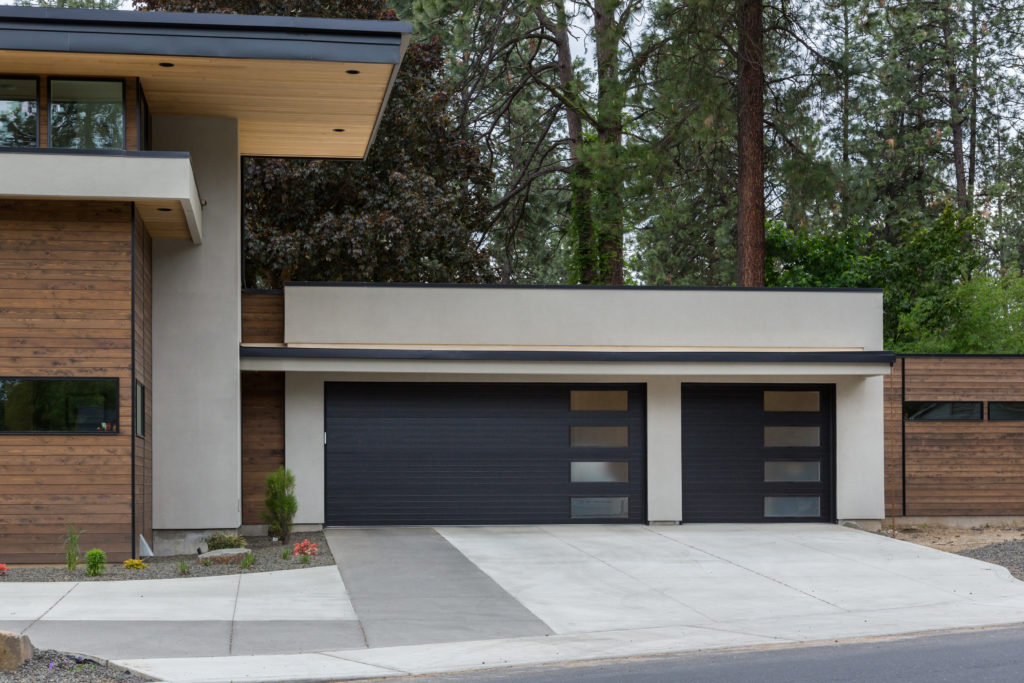
The midcentury style focuses on conveying a modern look through clean geometric lines, simple framework and asymmetrical design. This striking style juxtaposes traditional and contemporary elements for a unique, eye-catching appearance.
When matching your garage door to your midcentury home, consider implementing these common style components to keep the look alive:
- Thin, horizontal wooden slats
- Broad, vertical windows
- No external hardware
- Flat, flushed exterior panels
- Dark and medium wood accents
Pick Your Garage Door’s Color
When choosing a color scheme for your garage door, ask yourself if you’re looking to match the color of your home, complement it or add an accent with a contrasting color. If you decide to incorporate multiple hues or patterns, be sure that the design enhances your home rather than minimizes it. Matching your garage door color with the color of your front door is a sure way to create a uniform, cohesive look.
Some popular midcentury color schemes include:
- Light colors: White, gray, beige.
- Earth tones: Browns, greens, reds.
- Bright colors: Orange, blue, yellow.
Install Bridgeport™ Steel Midcentury Garage Doors
If you want to match your garage door to your exterior without the hassle, consider choosing from the Bridgeport™ Steel line — a high-quality collection featuring countless garage doors for midcentury homes.
These stylish, modern doors are highly durable with wood stile symmetry, rail door designs and three-layer steel Intellicore® construction. Bridgeport™ Steel doors boast quiet operation, exceptional strength and energy efficiency for year-round comfort. These low maintenance doors come in dozens of styles, including narrow and extended recessed panels and numerous window options.
Our new shaker style garage doors come in countless design choices, finishes and hues, including rich colors like glacier white, sandstone, mocha brown and almond. These doors are made with environmentally friendly materials and come with sleek decorative hardware components.
Purchase Your Shaker Style Garage Door Today
For sleek, eyecatching midcentury garage doors, choose Continental Door. For over 15 years, we’ve passionately provided our customers with the highest quality products and services to help them achieve their perfect exterior.
Browse our Bridgeport™ Steel collection today!
Shop Bridgeport™ Steel collection
Contact UsHow to Troubleshoot Common Garage Door Opener Problems
If you’ve ever lived somewhere that required you to park your car outside, you know what a convenience it is to have a garage. Parking outside leaves your car exposed to the elements, which can lead to plenty of problems.
However, when you start to have garage door opener issues, the convenience is quickly negated. If the door only closes partway or doesn’t respond to the remote, it can be frustrating to deal with it when you don’t know what the problem is or what you should do about it. In this guide to garage door opener troubleshooting, we’ll discuss a number of issues and how you can diagnose the source.
Request ServiceCommon Problems With Garage Door Openers
Even once you’ve pinned down the problem itself, it can still be challenging to determine the reason for it, and even more challenging to figure out how to fix it. Thankfully, the odds are high that it comes down to one of a few common reasons your garage door opener isn’t working.
Here’s a basic overview of each major issue, with an explanation of each possible cause and solution. Be aware that you may be having more than one problem at once, in which case the same cause will probably apply to both of them.
1. Garage Door Opener Switch Doesn’t Work
When you push the wall switch that operates the garage door opener and nothing happens, it may stem from one of the following issues:
Door Is Locked
A simple explanation for the problem may be that the door is locked. Most garage door switches have two buttons — one for opening and closing, and another for locking. If someone has pushed the lock button, whether intentionally or not, they’ve stopped the door from being able to open. Test this by pushing the lock button and trying again to open the door. If it works, you’ve solved the issue.
Motor Is Unplugged
An equally simple explanation may be that the motor is unplugged. Take a look at the motor, which is attached to the light near the ceiling at the end of the garage door chain. If the plug coming out of it isn’t inserted into the socket, you’ve found the problem. Just plug it back in, and you should be in good shape.
Photo-Eyes Are Faulty
A safety feature that exists in nearly all garage doors is the photo-eye sensor. Two sensors are placed at the bottom of the garage door opening, one on each side. These sensors project a beam of light to each other to verify that the opening is clear. If anything interrupts that beam, the photo-eyes prevent the door from closing. This is meant to prevent the door from hurting anyone or damaging anything in the process of closing.
Be aware that this should only affect closing, so if you can’t open the door either, the issue is probably something else. If the photo-eyes are to blame, though, you can easily fix them. First, make sure nothing is interrupting the beam. Then, check that the sensors are properly aligned to face one another. Finally, wipe off the lenses of each photo-eye to ensure that their line of sight isn’t clouded over with anything.
Circuit Breaker Is Tripping
If the door is unlocked and the motor is plugged in, it may be that the circuit breaker is tripping, or that a fuse has burned out. There’s a good chance you won’t be able to turn on the lights or other electric appliances in the garage either if this is the case. To fix this, try resetting the circuit breaker.
Motor Is Burnt Out
When you’ve tried all of the other options and still haven’t fixed the problem, it means you most likely have a burnt-out motor. At this point, it’s time to call a professional. They’ll have a look at your garage door opener, and after verifying the cause, will repair or replace your motor for you.
2. Garage Door Keypad Doesn’t Work
Not every home has a keypad to open the garage door, but if yours does, it can become faulty, too. If you put in the number sequence that you’ve programmed the opener with, only for the door to stay put, it could come down to a few different issues, such as:
Door Is Locked
As with the switch, it may just be that the door is locked. Try pushing the button on the switch to unlock it, and then put in the number on your keypad again. If it still doesn’t work, and particularly if you’re still able to open the garage door with the switch, the problem is probably specific to the keypad.
Batteries Are Dead
It can be easy to forget, but keypads aren’t usually plugged into the wall — they run on batteries. To keep them running, you’ll have to replace those batteries on occasion. The solution may be that simple. Replace all the batteries and see if it fixes the problem.
Keypad Is Out of Range
Unlike the wall switch, keypads aren’t directly connected to the garage door opener. They send a signal telling it to open, but that signal only has a certain range. If your keypad isn’t working, it may just be installed too far away from the garage door mechanism. Try operating it at a closer distance.
Photo-Eyes Are Faulty
As with the switch, it may be that the photo-eyes are keeping the door from closing. Check that nothing is blocking the connection between the two sensors, ensure they’re both aligned properly and wipe off each of the lenses. Again, this problem should only impact closing, so if you can’t open the door either, the issue lies somewhere else.
Keypad Needs Reprogramming
You can also try reprogramming the code you use to open the garage door with the keypad. You can check your manual for the exact details of how to do this on your particular opener, but it usually involves pressing a “learn” button on the motor and then inputting your desired code on the keypad. This process should essentially reset the motor to recognize the code being sent to it.
Antenna Is Faulty
When all else fails, the issue may not even be with the keypad itself. The keypad might be sending a signal just fine, only for the opener not to pick it up. There should be an antenna on the motor to receive the keypad’s signal, pointing straight downward. Double-check this antenna to verify that it’s secure and that it’s not pointing off in some other direction.
If you still can’t get it to work, but you suspect the antenna is the cause of the problem, you can call a professional to diagnose and fix your garage door opener.
3. Garage Door Opener Remote Doesn’t Work
In the same vein as the previous two problems, there can be times when you press the button on your remote, and the garage door doesn’t move. Here are a few potential causes, and how to fix them:
Door Is Locked
Once again, it may be that your door is simply locked. Press the lock button on your wall switch and try using the remote again.
Batteries Are Dead
Like with the keypad, you may simply need to replace the batteries in your remote. Try installing new ones, and see if the door opens.
Remote Is Out of Range
Also, like the keypad, your remote sends a wireless signal to the motor. From too great a distance, that signal won’t work. You may just be too far away — make sure you’re standing close enough to the motor when you use the remote.
Photo-Eyes Are Faulty
Once more, the photo-eyes may be responsible, though only if the malfunction is limited solely to closing. Check the connection path, ensure alignment and wipe the lenses.
4. Garage Door Doesn’t Close Properly
In some cases, the door will move when you push the button, only to malfunction partway through. Maybe it opens without a problem, but won’t fully close. Whether it doesn’t close at all, closes partway and then stops or closes all the way before immediately reversing and going back up, here are some possible causes and solutions to the problem:
Limits Are Off
It’s easy to take for granted that your garage door naturally stops in the right place when it opens and closes, but this isn’t inherently the case. The opening mechanism is programmed with a limit that tells it when to stop closing, so the motor doesn’t try to keep pushing it into the ground. If this limit is off from what it’s supposed to be, the door won’t stop in the right place.
Most openers let you adjust the limit by simply turning a screw in the motor. Check your manual for how this process works on your particular installation. If your door keeps trying to run into the ground, you’ll need to bring the limit back, whereas if the door doesn’t close all the way, you’ll want to push it forward a bit. Make sure you’re adjusting the “close” limit and not the “open” limit.
Photo-Eyes Are Faulty
If you haven’t already done so, give the photo-eye sensors a look. Some photo-eyes prevent the door from moving at all if their connection is broken, but others will let the door close partway before reversing its movement, or will simply stop it halfway down the track. In any case, you can fix this problem by clearing the path between the sensors, making sure they’re aligned and wiping off the lenses.
Rollers Are Damaged
Particularly if the door closes part way and then stops, the issue may be with the rollers or the metal tracks they roll along. The metal parts of the opener are susceptible to issues like rust, and in winter, they can contract slightly, causing resistance to the door’s movement. With enough resistance, the door will stop moving.
Check your rollers to see if this is the problem. A common solution is to apply lubricant oil to the rollers to help them move more smoothly. If that doesn’t work, it may be because the metal has become warped. Call a professional to have them examine the possible damage and help you repair the mechanism.
5. Garage Door Doesn’t Open Properly
If your doors aren’t having trouble closing, you may be encountering the opposite problem. Maybe the door will close well enough, but just won’t open — or perhaps it will open partway, but then stop. In either of these cases, the issue likely comes down to one of two things.
Limits Are Off
Just as your garage door has a limit for closing, it has another that tells it how far to open. If that limit isn’t set far enough back, the door will only open partway. Alternatively, it might be set too far, in which case you’ll hear the motor keep running even after the door’s stopped moving.
You can treat this issue by adjusting the “open” limit screw on the motor — again, consult your manual for the details on how to do this for your particular installation. Verify that you’re adjusting the “open” limit and not the “close” limit, and then move it accordingly, so the door stops in just the right place.
Rollers Are Damaged
Just like if your door has trouble closing, the issue may be that it has problems with the rollers. Try lubricating it to start with, and see if that fixes the problem. If it doesn’t, the metal tracks may be warped. To get that fixed, you’ll be best off calling in a professional to look at it.
6. Garage Door Motor Runs Without Door Moving
You may find that the motor responds to all of your controls without a problem — the door just doesn’t move. If you can hear the motor running, but the door stays put, there are two possible causes.
Limits Are Off
Once more, the issue may be that your limits are off. Note that if this is the cause, the door will still move, but the motor will simply keep running after it stops. This occurrence could happen in either direction, so you have to listen for when it does. In either case, you’ll need to dial back the appropriate limit, so the motor doesn’t keep trying to move the door after it’s gone as far as it can.
Door Is Disconnected From Belt
If the door doesn’t move at all, but you still hear the motor running, the door is probably disconnected from the belt. This disconnect most likely happened when someone pulled the emergency release cord. The specifics of reattaching the belt depend on the specific installation you have, so check your manual, but it should be a fairly straightforward manual process.
If this doesn’t fix the issue, the problem is likely beyond anything you should attempt to handle on your own. At that point, it’s time to call a professional for help.
Get Your Garage Door Opener Serviced Today
If you’re lucky, the issue you’re experiencing will be minor and something you can easily fix on your own. But, if you try each troubleshooting tip and none of them works, you know you need to bring in a professional who has the right experience to get the job done.
When that happens, look no further than Continental Door. We offer residential service throughout the greater Spokane, Washington, area and work with various brands such as Clopay, Linear and LiftMaster. We’ll be happy to take a look at your garage door and help you get it back in working order. Just get in touch with us today to get started!
Contact UsHow to Measure Your Bay Doors
Measuring Bay Doors
For businesses that operate out of a warehouse, bay doors simplify the processes of loading and unloading. But even with regular maintenance, bay doors need to be replaced from time to time. Taking careful measurements of the door opening is the first step in the process to install a new warehouse bay door.

Why Measure a Bay Door for a Warehouse?
There are a few different reasons one might measure the bay doors of a warehouse, though the most common reason is the installation of a new garage door.
You probably already have an idea of typical loading dock dimensions, even if it’s your first time installing a warehouse bay door. But bay doors are a significant investment, so you should be sure that you have the correct measurements before taking any further steps.
How to Measure for Bay Doors
The process of measuring for warehouse bay doors is fairly simple. All you need is a standard tape measure. When you’re ready, follow these steps:
1. Measure the Width of the Bay Door
Width is the distance between the left and right sides of the opening of the warehouse bay door. Be sure to measure from the widest point and record the measurement in feet and inches.
2. Measure the Height of the Bay Door
Just like you did with the width, measure the height at the bay door’s highest point: from the floor to the top of the finished opening.
You should measure the height at three different points (left, right and center) to make sure that the opening isn’t sagging on either side. If it is, there could be issues with garage door installation — so any sagging should be addressed before the installation process.
3. Measure for the Vertical Track
Next, measure the width of the area next to the openings on each side of the bay door. There should be between 3 and 3 3/4 of an inch on each side to accommodate the vertical track for the new garage door.
4. Measure the Headroom
The headroom is the distance from the top of the door’s opening to the ceiling. The headroom should be at least 6 inches for fitting the garage door opener and the torsion system.
5. Measure the Backroom
The backroom is the distance from the opening to the rear of the garage.
Determining Your Ideal Bay Garage Door Size
The ideal bay garage door opening is large enough to accommodate the opening of a full-size trailer. However, the door should not be larger than necessary so as to avoid the need for more insulation.
To provide total access to the entire height and width of a full-size trailer, standard loading dock dimensions specify that the warehouse bay door should extend between 13 and 14 feet above the parking area — the full height of the trailer.
Visit Continental Door For Commercial Garage Doors
Protect your business assets from the elements by investing in an insulated garage door that’s built to last. A door that properly fits your space will help lower utility bills and make warehouse access easy, so it’s crucial to have all the measurements correct before requesting the installation.
Continental Door is your one-stop headquarters for commercial and residential garage doors in the Greater Spokane area, and we’re always happy to help customers select the right door for their space and usage requirements. Request a free estimate or schedule service today.